
Generation of Static Electricity by Friction
Matter is made up of extremely small particles called atoms. An atom consists of a positively charged (+) nucleus and negatively charged (−) electrons. Normally, the amounts of positive and negative charge in an atom are equal, so the atom as a whole is electrically neutral.
When two electrically neutral objects are rubbed together, electrons may move from one object to the other. The object that gains electrons has an excess of negative charge and becomes negatively charged, while the object that loses electrons has fewer negative charges and therefore becomes positively charged.
For example, when a plastic comb is rubbed through a cat’s fur, electrons move from the cat’s fur to the comb. As a result, the comb becomes negatively (−) charged, while the cat’s fur becomes positively (+) charged. The process by which an object becomes electrically charged is called ‘charging‘, and an object that carries an electric charge is called a ‘charged object‘.
Electrostatic Induction
When a negatively (−) charged plastic rod is brought close to an uncharged aluminum can, the aluminum can is attracted toward the plastic rod. Why does this happen?
Metals such as aluminum contain many electrons that can move freely. When a negatively charged plastic rod is brought close to an aluminum can, the electrons in the can experience an electric force that repels them away from the plastic rod, causing them to move toward the far side of the can. As a result, the side of the aluminum can closer to the plastic rod becomes positively (+) charged, while the far side becomes negatively (−) charged. An attractive electric force then acts between the aluminum can and the charged object, causing the can to move toward the charged object.
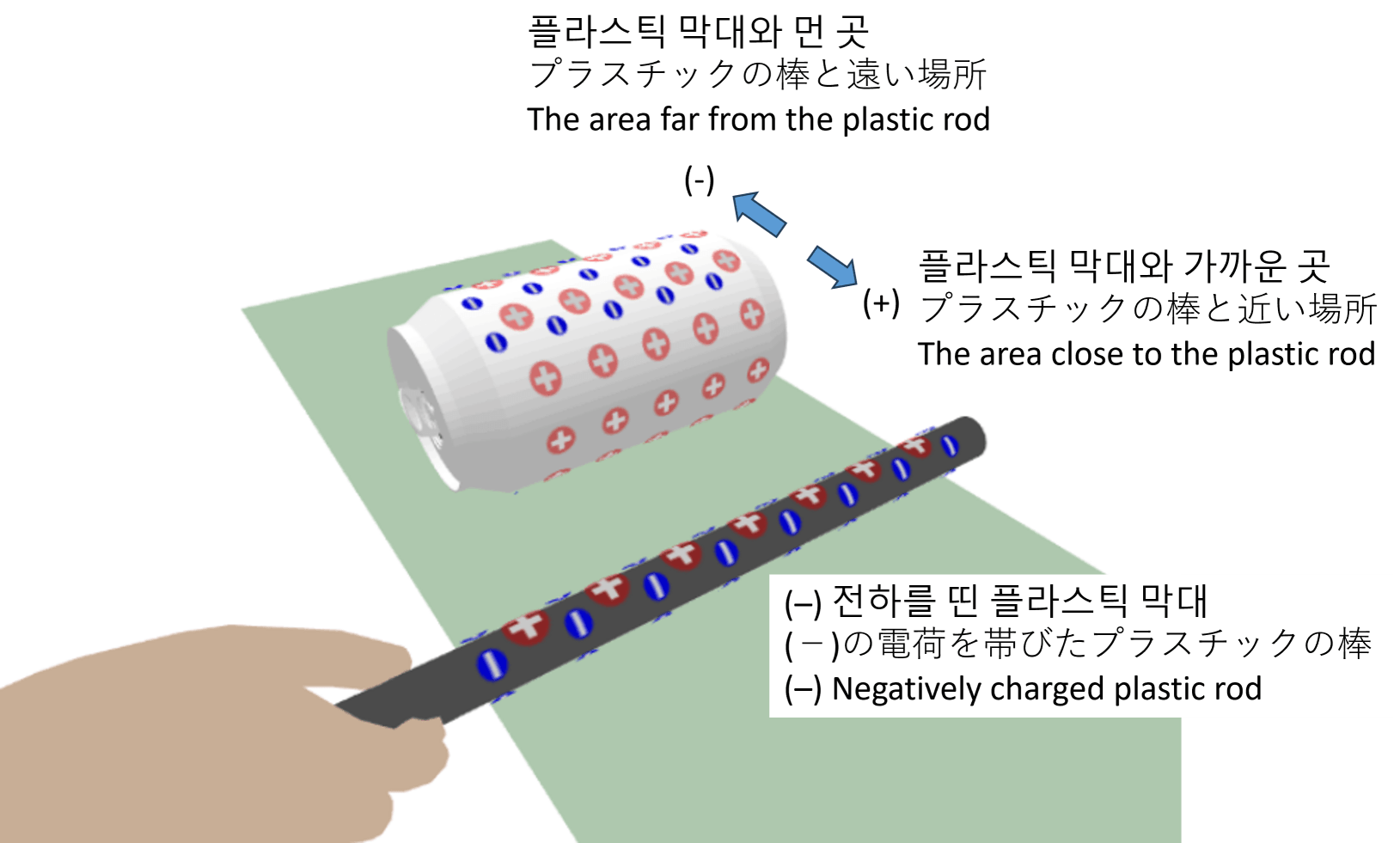
In this way, when a charged object is brought close to an uncharged metal object, the side closer to the charged object becomes oppositely charged, while the farther side develops the same type of charge as the charged object. This phenomenon is called ‘electrostatic induction‘.